
It is also known as Transgenerational Analysis;
Psychogenealogy is a therapeutic method that focuses on the study of family history — of significant events, traumas, secrets and unspoken things that can have an impact on the lives of descendants. According to this approach, the wounds and behavioural patterns inherited from our ancestors can be passed down from generation to generation, and influence the way we think, feel and act in the present.
Work in psychogenealogy consists of travelling back up the family tree to identify the significant events, the illnesses, the bereavements, the limiting beliefs — every kind of heaviness that may have affected the family's life and that holds the patient back today. By becoming aware of these links, they come to understand the reason behind repetitions of behaviours, choices and events: they are in fact repeating all of this unconsciously, out of family loyalty.
Read more about unconscious family loyalty here
Psychogenealogy can be helpful in understanding the origins of certain emotional or behavioural difficulties, such as anxiety, depression, phobias, addictions, eating disorders, relationship difficulties, and so on. By working on the unconscious mechanisms that have been transmitted from generation to generation, the patient frees themselves, finds peace, and finds a new balance in their life.
Their work also makes it possible to begin the healing of their whole line, thanks to the shift in the energy of events within the tree. They are the last link in the chain, choosing to break the cycle of suffering — and at the same time freeing their own descendants from the transmission of negative memories.
Read more about family transmission here
While it brings to light the inheritance of negative events and their repercussions, psychogenealogy also reveals the positive inheritance of the tree: the qualities, the models passed down, the positive beliefs, and so on. In short, it relieves the descendant of negative transmissions so that they keep the beneficial lessons.
Origins and history of psychogenealogy
"Psycho-genealogy" — the psychology of our ancestors — has its origins in the psychoanalytic tradition. From the 1970s onwards, French psychoanalysts such as Anne Ancelin Schützenberger and Didier Dumas began taking an interest in patients' family histories, seeking to understand the links between past events and present-day difficulties.
It brings together the following disciplines, adding to them the genealogical dimension and the repetition of patterns:
- Transactional analysis: the analysis of interactions between people and of "why" they communicate as they do.
- Neuro-linguistic programming (NLP): the analysis of a person's relationship with themselves, their strategies for success or failure, and what they draw from their experience in how they learn.
- Systemic analysis: the analysis of how a person acts within their systems (family, work, friends…) and the effects of this. Over the years, psychogenealogy has developed in France and in other countries, giving rise to many variations and adaptations. Today it is regarded as a complementary therapeutic approach. It can be helpful alongside other forms of therapeutic support, such as psychoanalysis, psychotherapy, family therapy, brief therapy, and so on.
Who is psychogenealogy for?
Psychogenealogy is for anyone who wishes to understand the links between their family history and their current difficulties (relational, professional, financial…)
The reasons that may lead someone to consult a psychogenealogist are very broad. Among them:
Better understanding your identity and your place within the family
Understanding your family and cultural inheritance
Difficulty making choices, or finding your path
Difficulty freeing yourself from family expectations
A sense of family heaviness (secrets, unspoken things, conflicts, dysfunction)
Issues related to fertility and parenthood
Repetitions of situations, events and choices
The consequences of moral, physical or sexual abuse
Unresolved grief (sudden deaths, premature losses…)

Choosing your psychogenealogy therapist well
Choosing a psychogenealogy therapist is an important step for the success of the therapy. Here are some things to consider in order to choose well:
The therapist's qualifications:
make sure the therapist has trained in psychogenealogy or in a similar therapeutic approach. Check their skills and their professional experience.
You may come across several different professional titles among those practising in the field of psychogenealogy. Here they are, in order of qualification:
- Technician in psychogenealogy
- Practitioner in psychogenealogy / Transgenerational therapist / Psychogenealogist
- Master practitioner in psychogenealogy (multidisciplinary psychogenealogist)
(Please note: many therapists practising psychogenealogy are neither trained nor certified.)
Recommendations:
look at the reviews and testimonials from other patients across the professional's different platforms (Google, website, social media…)
The relationship with the therapist:
the relationship between therapist and patient is very important in therapeutic support generally. Make sure you feel at ease with the person, that the connection feels easy and trusting, so that your work is as beneficial as possible. Trust how you feel during your first conversations.
Every therapist, like every individual, has a different world and a different energy — find the one that matches your sensibility.
The methods and techniques used:
ask the therapist which methods and tools they use in psychogenealogy, and how they work. Not all professionals use the same tools. Find out about theirs so you know whether they suit your needs.
Fees:
find out about the therapist's fees, as well as payment arrangements. Make sure the cost of the therapy is affordable for you.
By taking all of these elements into account, you will be able to choose a psychogenealogy therapist who suits your needs, your expectations and your sensibility.

Tools and methods that complement psychogenealogy
Alongside conversation, there are various complementary tools for exploring the links between family history and a patient's current difficulties.
Here are some examples:
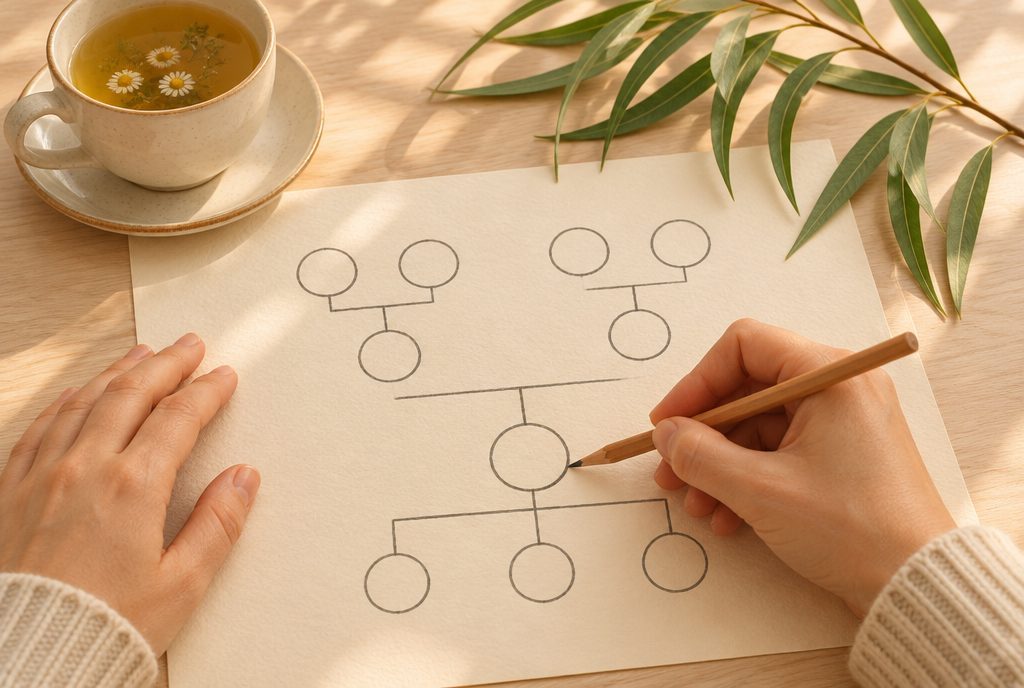
The intuitive family tree drawing:
the patient draws their tree intuitively — the way they picture their family — and places themselves on it. The therapist then interprets the drawing, which is rich in meaning, since it is the unconscious that has represented their vision of the genealogy.
Building the genogram (also called a genosociogram, or the standardised tree in psychogenealogy):
The therapist and the patient build the family tree together, filled with all the family information, significant events, dates, links between people, and so on — arriving at an overall view that will serve the analysis.
Symbolic acts:
The therapist suggests a personalised action for the patient to carry out, based on their history, the situation to be untangled, and their personality. The act makes it possible to cancel the negative energy transmitted by an event (or by the bond to an ancestor) within the line, and to replace it with a positive energy; it is a reprogramming within the descendant's reptilian brain.
Imprint change, or Ericksonian hypnosis applied to psychogenealogy:
Through this hypnosis exercise, the therapist travels back through the generations of the patient's line, questioning family memories in order to identify the "source" ancestor who lived through the traumatic event connected to the descendant's present-day problem. Once the ancestor's memory has been healed, the entire line (as well as the descendant) is freed from the imprint of that memory.
Numerology applied to psychogenealogy:
This makes it possible to analyse the dates within the patient's genogram: repeated dates, dates that resemble one another — and therefore to interpret in detail the links between people, between events, and so on.
Family constellations:
The therapist gathers a group of people, from whom the patient chooses those who will represent family members involved in a conflict they have not been able to resolve. They watch the scene of that conflict played out in front of them, which reveals hidden aspects of the event, allowing them to develop a new perspective and, sometimes, to resolve the conflict.
Visualisation:
this technique consists of returning to family scenes in order to explore the emotions and feelings associated with them. It makes it possible to connect with buried memories and to understand them better.

How does psychogenealogy support unfold?
Psychogenealogy support can vary from one therapist to another, but here is a general overview of what you can expect:
Some therapists offer a free initial phone conversation to make contact and to let you express what you are looking for. This allows the therapist to know whether the issue really does fall within psychogenealogy, and whether they can help you or should refer you to another professional.
The first session: For the first session, you arrive with certain family information gathered beforehand — requested in advance by the therapist. This is information that you already know. (What you do not know can be retrieved from the family unconscious with the help of hypnosis.)
You also bring the sketch of your intuitive vision of your family tree, and the therapist interprets it.
The first sessions (the beginning of the work): The therapist builds the genogram in collaboration with you. This is your family tree with all the events, the dates, each person's story, the links between people, and so on. This phase takes a few sessions, depending on what you know of your tree and on the number of generations the therapist chooses to explore consciously (with known elements).
The following sessions (the middle of the work): The next sessions are devoted to analysing and bringing to light the unconscious loyalties within the tree, going deeper, exploring, working on emotions and feelings, rebalancing family bonds, integrating what has been discovered, and so on. The therapist uses their various tools and methods both during and outside sessions (symbolic acts, for example, are carried out by the patient outside the session) in order to work towards the goals and the resolution of the issues.
The end of the work: once the goals of the work have been reached, the therapist will offer you a closing session to take stock. If other things remain to be worked on, you will continue on another theme; if all the goals have been addressed and reached, the work comes to an end.
Psychogenealogy support is a personal and evolving process that can vary from one person to another. It calls for commitment and motivation in order to explore your family history and your present-day difficulties in depth.
How many sessions should you allow for psychogenealogy support?
The number of sessions needed will depend on several factors, such as the goal of the work, the complexity of the family history, how often the sessions take place, how regular the appointments are, and so on. It is difficult to give a precise figure, because every piece of work is different.
It is common to allow for between 5 and 15 sessions.
It is important to stress that work in psychogenealogy takes time and patience. There may be moments of greater or lesser discomfort to move through, but they are often necessary in order to progress and for the process of release.

How much does a psychogenealogy session cost?
The cost of a psychogenealogy session can vary depending on several factors, such as the geographical region, the therapist's experience, the length of the session, and so on. In general, the cost of a psychogenealogy session is between 50 and 150 euros.
It is worth noting that some psychogenealogy therapists may offer adjusted rates depending on their patients' financial situation. It is therefore advisable to ask the therapist about their fees and how they work.
Books and works on psychogenealogy
There are several books and works on psychogenealogy that can be useful for deepening your understanding of this practice. A few examples:
- Aïe, mes aïeux ! by Anne Ancelin Schützenberger
- La boîte à outils de la psychogénéalogie by Anne Ancelin Schützenberger
- La psychogénéalogie : Comprendre son histoire familiale et mieux se connaître by Sophie Guedj-Metthey
- La psychogénéalogie pour mieux vivre sa vie by Marie-Lise Labonté
- Le grand livre de la psychogénéalogie : Les secrets de famille, de la psychothérapie à la spiritualité by Chantal Rialland
- L'arbre de vie : Introduction à la psychogénéalogie by Michel Diviné
- Voyage au pays des aïeux by Maria Dolorès Sanchez
And many others…
These books address different aspects of psychogenealogy, such as analysing the family tree, the impact of family secrets, transgenerational traumas, and so on. They can be an excellent resource for better understanding this practice and deepening your self-knowledge.
Marina Lecroart K – All rights reserved
 To book an appointment or request information: click on the image